Cost guide
How Much Does Hardwood Flooring Cost in Toronto? (2026 Guide)
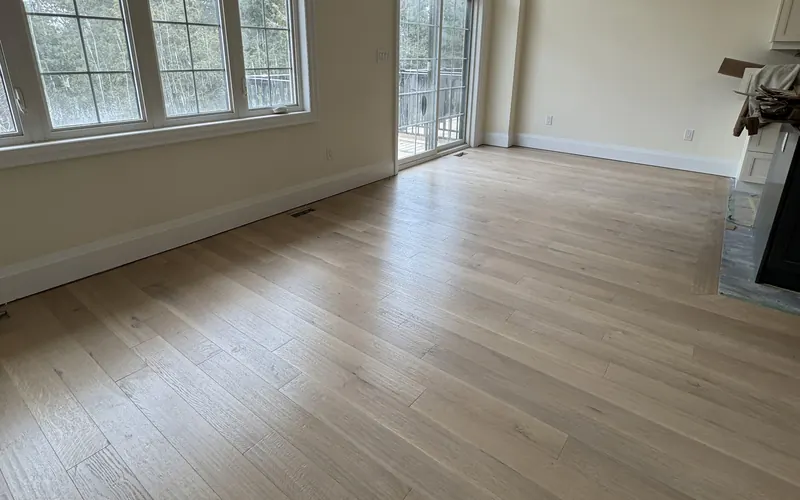
Installed hardwood flooring in Toronto costs $8 to $18 per square foot in 2026, material and labour included. Engineered hardwood material alone runs about $4 to $9 per square foot; the rest is installation, underlay and finishing details. For a 600 sq ft condo that works out to roughly $4,800–$10,800. For a 1,000 sq ft main floor in a North York or Etobicoke house, plan on roughly $8,000–$18,000 before stairs and trim.
These are planning numbers, not quotes. They come from the jobs we price across Toronto and the GTA, and they're meant to help you set a realistic budget before anyone measures your space.
What’s included in $8–18 per square foot?
A proper installed price covers four things:
- Material. The flooring itself. Most engineered hardwood Toronto homeowners choose falls between $4 and $9 per sq ft. Wider planks, thicker wear layers and premium species like rift-and-quartered white oak sit at the top.
- Installation labour. Nailing, gluing or floating the floor, undercutting door jambs, and cutting around vents, cabinets and columns.
- Underlay and adhesive. Moisture barrier, acoustic underlay for condos, or glue for glue-down installs.
- Transitions. Thresholds, reducers and flush nosings where hardwood meets tile, carpet or a stair.
What's usually not in the per-foot price: removing old flooring, subfloor repair, stairs and baseboards. Those get priced separately, and they're where budgets slip if nobody mentions them up front.
What makes hardwood cost more or less in Toronto?
Subfloor condition
Hardwood is only as flat as what's under it. Levelling low spots, grinding high spots or replacing soft plywood adds $1–3 per sq ft. Older Toronto houses, from 1950s bungalows in North York to century homes in the east end, often need some of this. Condos on concrete usually need less levelling, but the slab still has to be checked for flatness and moisture before anything goes down.
Installation pattern
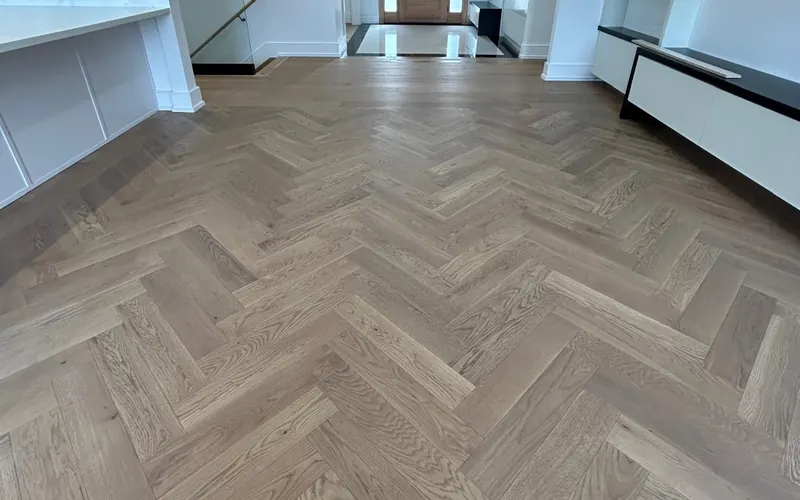
Straight lay is the baseline. Herringbone and chevron add 30–50% to labour and need 10–15% extra material for waste instead of the usual 5–7%. Our herringbone installation guide walks through that math.
Material choice
Plank width, wear-layer thickness, species and finish all move the material line. In condos, engineered hardwood is the practical default because it can be glued or floated over concrete; see choosing engineered hardwood for a Toronto condo.
Access and logistics
Elevator bookings, loading-dock windows, downtown parking and moving furniture all take time. None of it is dramatic, but it's real labour, and a good quote accounts for it instead of surprising you on day one.
How much does hardwood cost for a typical Toronto home?
Here's what the $8–18 range looks like on common GTA project sizes. Figures are installed, straight-lay, and exclude stairs, trim and subfloor repair.
| Project | Approx. area | Installed (2026) |
|---|---|---|
| Condo bedroom or den | 120–200 sq ft | $1,000–$3,600 |
| One-bedroom condo | 500–650 sq ft | $4,000–$11,700 |
| Two-bedroom condo | 800–1,000 sq ft | $6,400–$18,000 |
| House main floor | 900–1,200 sq ft | $7,200–$21,600 |
| Whole house, two floors | 1,800–2,400 sq ft | $14,400–$43,200 |
The spread inside each row is mostly material choice and prep. A mid-range engineered oak on a flat slab lands near the low end. A wide, long, thick-wear-layer plank over a subfloor that needs work lands near the top.
What do stairs and trim add to a flooring budget?
Stairs are priced per step: $150–350 per step, so a typical 12–14 step staircase runs about $2,500–$5,000. Our stair renovation cost guide breaks down what's in that number.
Baseboards and trim run $2–5 per linear foot installed. A whole main floor is often 250–400 linear feet, or roughly $500–$2,000. See baseboard and trim installation cost for how to estimate yours.
What can you get at each budget level?
- Under $5,000: one or two rooms, or a small condo in a mid-range engineered plank with minimal prep.
- $5,000–$10,000: a typical one-bedroom condo or a compact main floor, including transitions.
- $10,000–$20,000: a full house main floor, a larger condo in a premium plank, or flooring plus a staircase.
- $20,000+: whole-home installs, herringbone in the main living areas, or floors, stairs and new baseboards done together.
If you're between tiers, the usual lever is material: dropping from a premium wide plank to a good mid-range one can save $2–4 per sq ft without changing how the floor is installed.
How do you get an accurate hardwood quote?
Get the space measured in person, and ask for a written quote that lists material, labour, removal, subfloor prep, stairs and trim as separate lines. That's the only way to compare two contractors fairly. If one quote is much lower, it's usually missing a line, not cheaper. Our guide on how to choose a flooring contractor in Toronto lists the questions worth asking.
When you're ready for real numbers, request a free quote and we'll measure and price your space line by line.
Frequently asked questions
How much does hardwood flooring cost per square foot in Toronto?
In 2026, installed hardwood in Toronto typically costs $8–18 per square foot including material and labour. Engineered hardwood material alone is about $4–9 per square foot.
How much does it cost to install 1,000 square feet of hardwood?
Roughly $8,000–$18,000 installed for a straight-lay engineered floor, plus any subfloor repair ($1–3 per sq ft), stairs and baseboards.
Is engineered hardwood cheaper than solid hardwood?
Not always. At similar quality, the prices overlap. The choice is usually decided by your subfloor: engineered can be glued or floated over concrete, which is why it's the standard in Toronto condos, while solid hardwood needs a plywood subfloor to nail into.
Should I budget extra for subfloor prep?
Yes. Set aside $1–3 per square foot as a contingency, especially in older Toronto houses. A contractor should check flatness and moisture before quoting so it isn't a surprise mid-job.
How long does hardwood installation take?
Most 600–1,000 sq ft straight-lay jobs take two to five working days, plus any acclimation time the manufacturer specifies. Herringbone, stairs and heavy subfloor work add days.